What does our Milky Way look like?
Milky Way structure & dynamics
Catalogs of RR Lyrae stars can help using them as tracers for uncovering Galactic substructure to beyond the Milky Way tidal radius at ~300 kpc and revealing details of satellite galaxies.
Having a large sample of RR Lyrae stars at hand, spanning 3/4 of the sky and 10 to 130 kpc, we can easily access the Milky Way's halo and its stellar streams. Stellar streams, being remnants of disrupted dwarf galaxies, are of great interest because their orbits are sensitive tracers of a galaxy’s formation history and gravitational potential.
We focus here on the Sagittarius stellar stream, the dominant stellar stream of the Galactic stellar halo, for which we can present a comprehensive and precise description of its 3D geometry as traced by its old stella population.
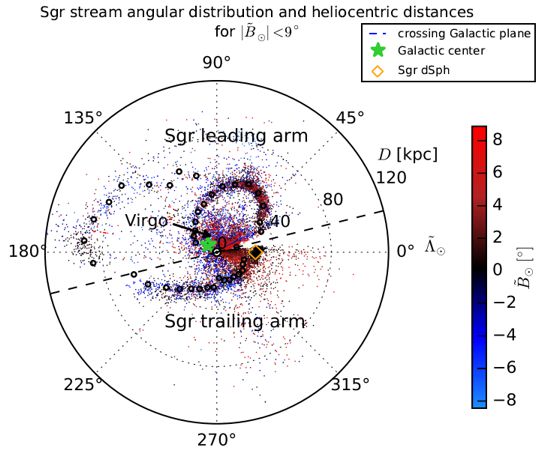
A projection of RR Lyrae stars within 9° of the Sgr stream's orbital plane reveals the morphology of both the leading and the trailing arms at very high contrast, across much of the sky. In particular, the map traces the stream near-contiguously through the distant apocenters. These improved geometric constraints can serve as new constraints for dynamical stream models.
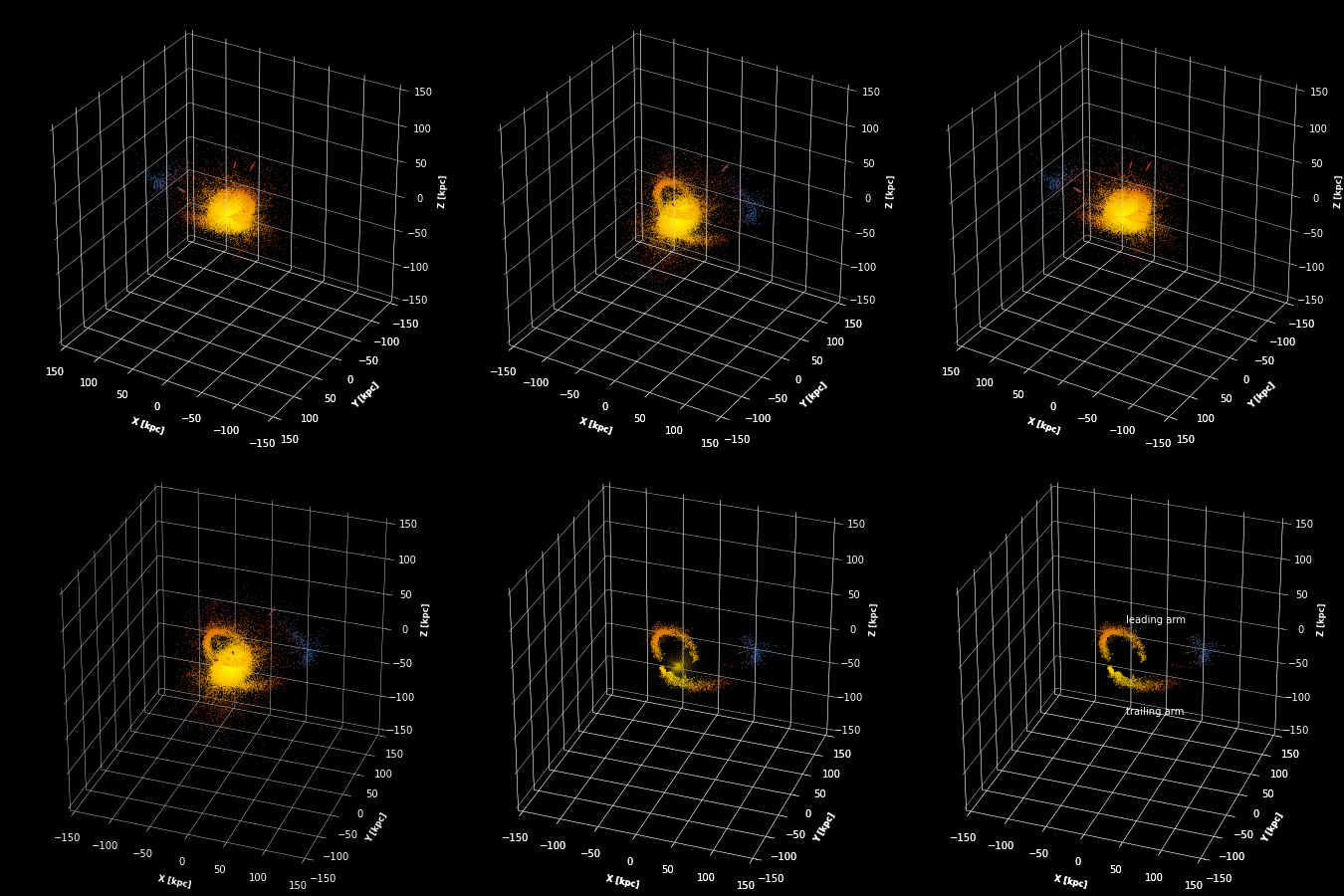
The following movie shows this sample of ~45,000 RRab stars, where the heliocentric distance is color-coded. Towards the end of the movie, most stars fade out, leaving only the RRab stars related to the Sagittarius stream.
download high-resolution AVI
Futhermore, we characterize the spatial density of the PS1 3pi sample of RR Lyrae stars, to study the properties of the old Galactic stellar halo as traced by RRab stars. We apply forward modeling using ellipsoidal stellar density models ρ(l,b,Rgc) both with a constant and a radius-dependent halo flattening q(Rgc). We find evidence for a distinct flattening of q~0.8 of the inner halo at ~25kpc, in contrast to a spheroidal outer halo. Additionally, we find that the south Galactic hemisphere is more flattened than the north Galactic hemisphere. We also find that the stellar halo, as traced in RR Lyrae stars, exhibits a substantial number of further significant over- and underdensities, even after all known overdensities have been masked.